Water
Electric well pumps and pressure systems need a deliberate backup path.
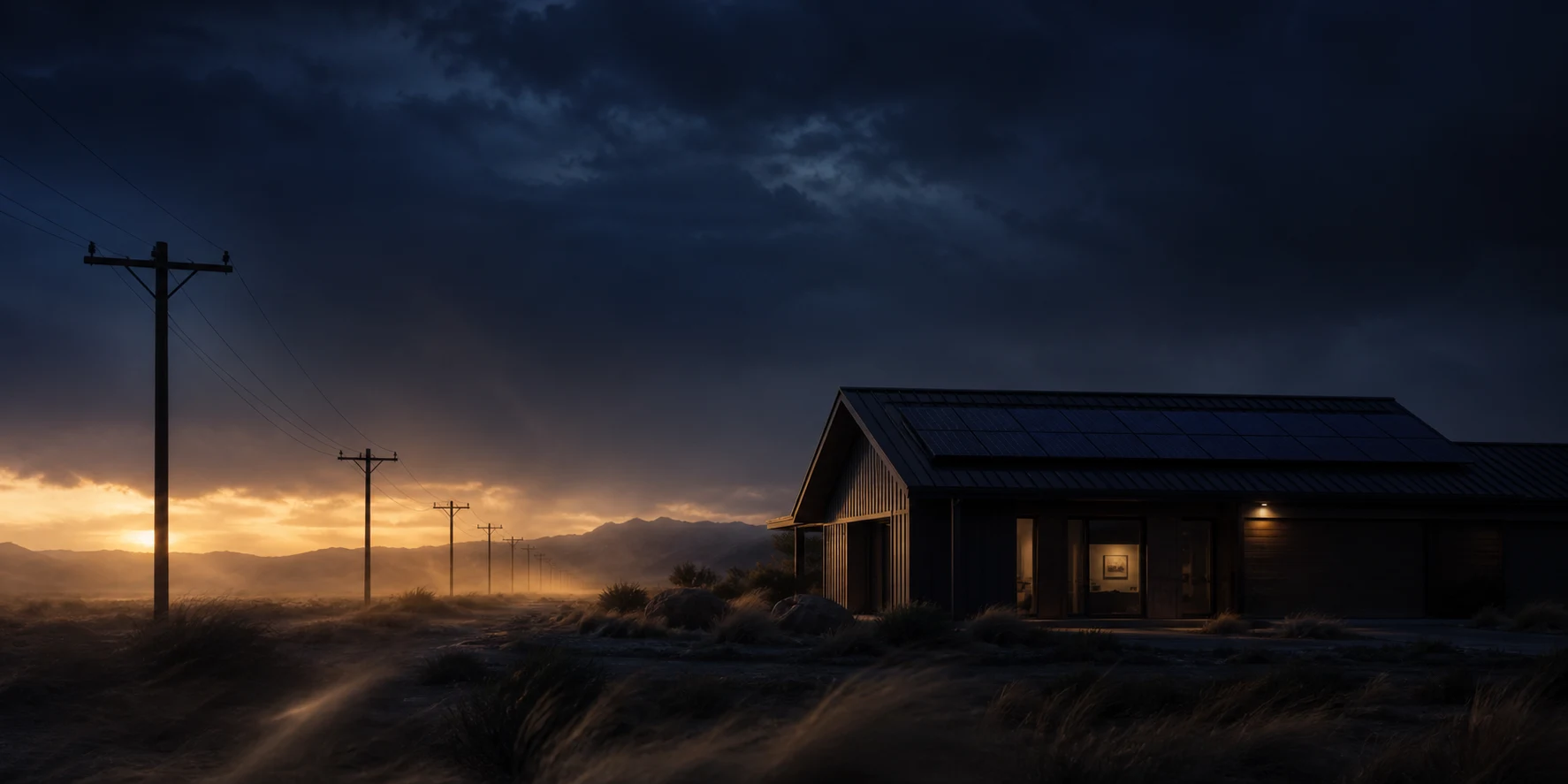
The cost of connectedness · 03
A planned wildfire shutoff, severe weather, or equipment failure can interrupt power. Plan around the loads your home depends on.
These are documented operating conditions, not hypotheticals. The consequences depend on your site, loads, and backup plan.
Ungrid turns battery, solar, load, and weather data into alerts and daily guidance. Fully off-grid or still connected and working toward energy neutrality: put the system you own on watch.
See supported systems and monitoringVictron VRM and EG4 Cloud monitoring · Read-only · Start free
Use these chapters to understand the tradeoffs, then bring your loads, reserve needs, and written quotes to a local installer.
Request an installer introductionSometimes failure is the plan
During dangerous wildfire conditions, California utilities can intentionally de-energize lines as a last-resort safety measure. In Southern California, a Santa Ana wind event can become a shutoff decision. The wind may never damage the line. The safety decision itself can still leave a community without power.
Public Safety Power Shutoffs reduce ignition risk. They can also interrupt homes, businesses, and essential services. Both facts matter.
Fire changes more than the lights
Utilities may de-energize equipment near active fire or smoke. For a home on an electric well pump, no electricity means no pumping. Stored water or gravity pressure may buy time. The pump itself is still offline.
Municipal water systems and properties with gravity storage or dedicated backup can behave differently. The dependency is site-specific.
Same outage. Different emergency.
For one house, an outage is an inconvenience. For another, it interrupts water, heat, food storage, communications, or medical equipment. Resilience starts by deciding which loads cannot be allowed to disappear.
Electric well pumps and pressure systems need a deliberate backup path.
Many fuel-burning heating systems still need electricity for controls and circulation.
Food and temperature-sensitive medicine turn elapsed time into a real constraint.
Power-dependent devices need an outage plan sized to the person, device, and duration.
The storm ends before the outage does
Severe winter weather can damage multiple parts of the system at once. Restoration is measured in access, crews, replacement equipment, and safe working conditions—not simply when the snow or wind stops.
Lights, internet, pumps, controls, and charging stop or move to backup.
Stored energy, water, heat, and refrigeration become operating decisions.
Fuel, battery reserve, communications, and access determine what keeps working.
A convenience backup is no longer a resilience system.
Some customers remained without power for four days after the February 2021 Texas freeze, according to the FERC/NERC final report.
Some customers waited up to eleven days after the October 2011 Northeast snowstorm, according to the federal review.
These are not four risks.
They are one dependency.
The grid is not malicious. It is a vast shared machine optimized for public safety, cost allocation, and restoration at scale. Your house sits at the far end of those priorities.
Connectedness has a second cost
Physical dependency is only half the story. Load growth, rate design, fixed charges, and public policy decide how the shared system is paid for.
Turn the plan into a site conversation
Share your ZIP code and build stage. Ungrid will review your request and email you if we identify an installer serving your area.
From conviction to operation
Ungrid helps homes, farms, and yachts understand what their energy system is doing now—and prepare for what comes next.
One morning, one clearer decision. An illustrative Sunrise Energy Brief: overnight use leaves less reserve, clouds shorten the next solar window, and the owner moves flexible loads into the expected clearing. Ungrid provides the context; the owner decides what to run.
The CPUC describes Public Safety Power Shutoffs as a last-resort practice during dangerous wildfire conditions and explains utility responsibilities.
CPUC PSPS overview ↗CPUC outage resources ↗The CPUC notes that an electric well pump will not work during a shutoff. CDC guidance covers outage planning for power-dependent medical devices.
CPUC PSPS FAQ ↗CDC power-source planning ↗Federal reviews document prolonged customer outages after the 2021 Texas freeze and 2011 Northeast snowstorm.
FERC/NERC Texas freeze report ↗Federal Northeast storm review ↗